Tag: creative space

  • What Actually Matters in a Home Creative Space

    What Actually Matters in a Home Creative Space

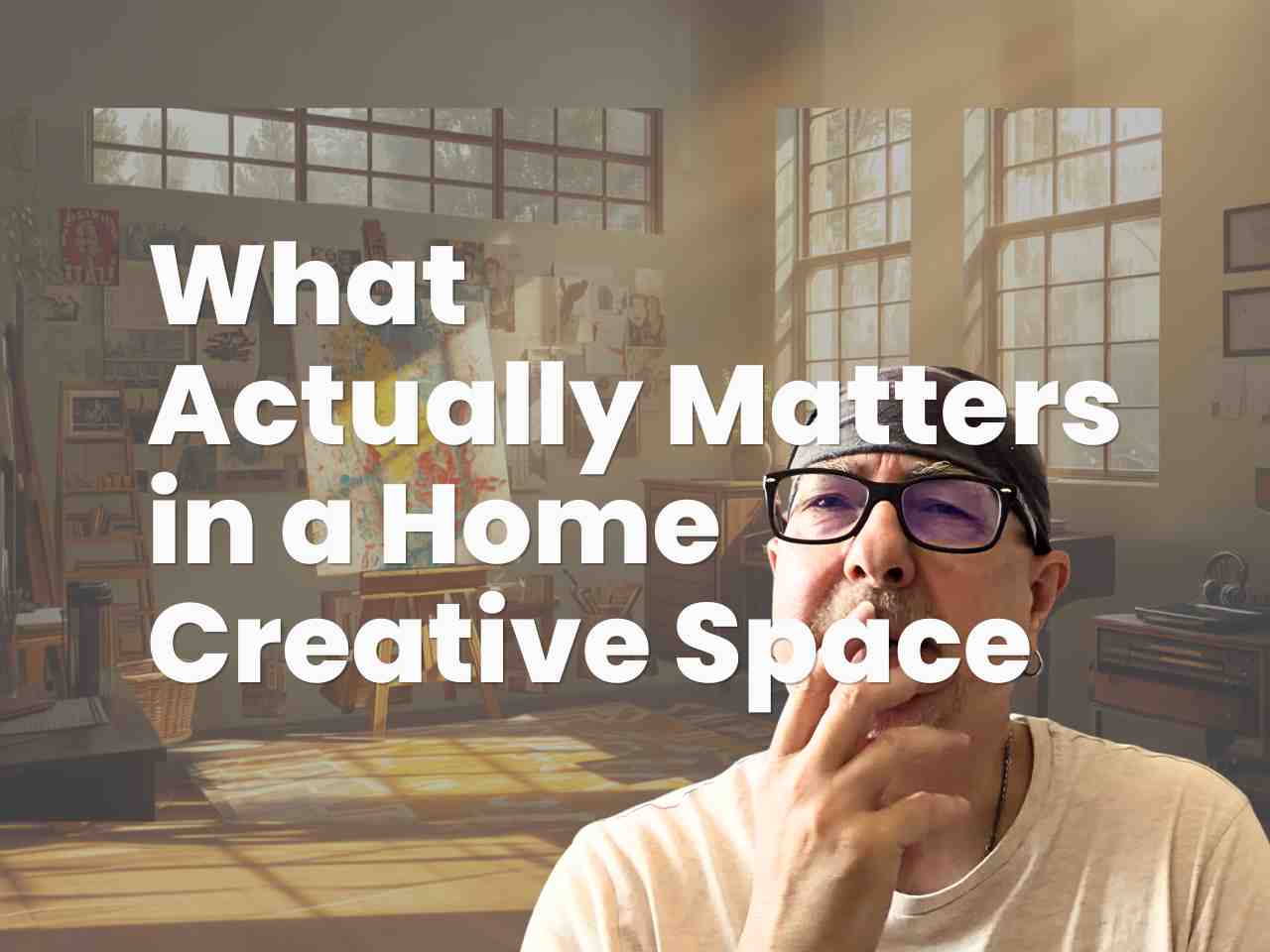
    What actually matters in a home creative space text with an image of a creative studio and me

    I want to tell you about the worst creative studio I ever worked in. A cupboard, basically. Barely enough room to swing a mic stand, one window that didn’t open, and a chair that made my back ache after twenty minutes. It was really cuboardy.

    Some of my proudest creative moments came out of that room.

    The point is, I think we get the home creative setup question backwards. We ask what we need to add: better acoustic treatment, a bigger desk, more shelving, more paint holders, more IKEA trolleys, a proper monitor stand, instead of the stack of books currently doing the job (my credit card company thanks me for that particular phase, by the way). And most of those additions, if I’m honest, barely made any difference to my creative output.

    So here’s what I think actually matters. Three things, and none of them cost anything.

    Your Creative Space Doesn’t Need to Impress Anyone

    This one took me embarrassingly long to work out. I used to think my space needed to look like the studios I saw online: the tidy shelves, the perfectly positioned monitors, the plant that’s somehow always thriving. I spent real money and real time chasing that perfect creative look.

    None of it made my creative output better. Writers don’t need the aesthetic writing desk from the magazine spread. Painters don’t need the studio with the north-facing light everyone, I mean everyone, talks about. Photographers don’t need the perfectly organised kit bag. What you need is a space that works for you, which is a much lower and much more achievable bar than a space that impresses anyone else, including yourself, scrolling through other people’s setups at midnight.

    I still catch myself doing it sometimes. Looking at someone’s beautifully lit desk and feeling my own workspace falls short by comparison. It’s a trap, and I don’t think I’ll ever be fully immune to it. But I know to kick myself now when it happens, which helps… and hurts.

    The Same Space, Over and Over, Does Something

    Choreographer Twyla Tharp writes about this in her book on creative habits: she describes how habitually creative people build rituals tied to their working environment, and how just entering that space starts the creative process before any actual work begins. She tells the story of Stravinsky, who played the same Bach fugue on piano every single morning before composing, in the same room, at the same time. Not because the fugue mattered, but because the ritual of that room, that routine, told his brain it was time.

    I didn’t understand this until I noticed it happening to me. There’s a specific corner of my house where, within a few minutes of sitting down, my brain just switches into work mode. It’s not a nice corner. It’s not well lit. But I’ve sat there enough times doing the same kind of work that the space itself has become part of the trigger.

    Bonus thought: if you don’t have a dedicated space, a consistent object works – the same notebook, the same chair, the same mug. The brain latches onto whatever repeats.

    This is worth more than almost any piece of gear, or “perfect” studio. A familiar space that reliably gets you into the work is doing something no upgrade can replicate.

    Clutter Is Quietly Taxing You

    The last one is the most measurable. Research out of Princeton found that visual clutter forces your brain’s visual processing centres to work through everything in view, whether you’re paying attention to it or not, and that this uses up mental resources you’d otherwise have for the actual task. A cluttered space really does create a cluttered mind. Oops!

    This doesn’t mean minimalist in the aesthetic sense, all white walls and empty surfaces. It means resolved. The distortion pedal you’re not using put away rather than left tangled on the floor. The reference photos you’re not currently using filed rather than pinned up alongside the ones you are. Not because mess is a moral failing; it absolutely isn’t, but because your brain is quietly spending energy processing all of it whether you like it or not.

    I’m not naturally tidy. But I noticed the difference when I started closing the loop on things I wasn’t using, rather than letting them accumulate in my eye line.

    I know this can be difficult. I have my guitar on a stand next to me, always. I look at it, and my mind immediately jumps to forming chord progressions. That’s great when I need to make some music, not so good when I am trying to write words on a screen or notebook. It can be a delicate balance, but worth one worth seeking.

    What to Do Instead

    Don’t audit your gear list first. Audit what’s actually in your field of view when you sit down to work, and clear out what isn’t earning its place there.

    Build a small, boring ritual around your space if you don’t already have one. It doesn’t need to be interesting. It just needs to be repeated.

    And the next time you’re tempted to upgrade something because someone else’s setup looked better online, ask yourself honestly whether the upgrade would change the work, or just the photo of the work. Usually it’s the second one.

    The cupboard I mentioned didn’t have any of the right gear. It had a chair, a window that didn’t open… but enough repetition that sitting down in it eventually just meant it was time to work. Turns out that was most of what mattered.


    Thank you for reading this post. Please share your thoughts in the comment section below.
    namaste
    d
    xox

    If you enjoyed this post please support my writing by making a donation of any amount.

    Sign up for my (ir)regular newsletter to keep up to date with my creative adventures, including special offers, and join me on Instagram | YouTube | Twitter | Pinterest

  • What Years of Creating Taught Me About Discipline

    What Years of Creating Taught Me About Discipline

    what years of creating taught me about discipline - text with an image of a strict school headmaster

    Introduction

    For a long time I thought creative discipline was something you did or didn’t have. The people who showed up every day and consistently created, they must have something I lacked. More willpower. More commitment. A stronger sense of purpose.

    So I’d try to force it. Push harder. Tell myself this time would be different. And for a while it would be. Then it wouldn’t.

    What I’ve learned, slowly and not without a fair amount of failed attempts, is that discipline isn’t about force at all. The people who seem most disciplined aren’t necessarily trying harder than everyone else. They’ve just built better structures around themselves. And those structures, those creative practices, do the heavy lifting that willpower, or certainly my willpower, can’t sustain on its own.

    Willpower fades. Systems don’t.

    The research on willpower is pretty humbling. The American Psychological Association summarises it well: self-control draws on a limited mental resource that depletes through use. Every decision you make, every temptation you resist, every moment you push through resistance costs something. And the tank runs dry.

    What’s more interesting is what the research says about people who seem highly disciplined. They don’t have stronger willpower. They’ve structured their lives to need it less. They’ve removed friction, built routines, and designed environments that make the right behaviour easier and the wrong behaviour harder. They’ve taken the decision out of it. (Source: What You Need to Know About Willpower, American Psychological Association)

    This was a significant shift for me. Discipline stopped being about trying harder and started being about designing better.

    Small commitments, consistently kept, build more than grand intentions

    One of the most useful things I’ve picked up over years of creative work is that small consistent commitments beat big ambitious ones almost every time.

    A daily creative session of twenty minutes that actually happens is worth infinitely more than an hour-long session you keep intending to have. The small commitment is achievable. You keep it. You build evidence that you’re someone who shows up. That evidence compounds.

    BJ Fogg’s research at Stanford backs this up. His Behavior Design work shows that motivation is the least reliable factor in building lasting behaviour. Instead, he advocates for making habits so small and easy that they don’t require motivation at all. The habit gains its own momentum once it exists. The size of the commitment is less important than the consistency of it. (Source: Tiny Habits, BJ Fogg, Stanford Behavior Design Lab)

    Environment matters more than intention

    Here’s something that took me longer to really absorb: your environment shapes your behaviour more than your intentions do.

    If your creative tools are put away, you’ll procrastinate more. If your notebook is on your desk, you’ll pick it up. If your guitar is in its case in the corner, it’ll stay there. If it’s on a stand in the room, you’ll play it. My guitar is within touching distance of my desk as I am typing this!

    James Clear puts this plainly: “You do not rise to the level of your goals, you fall to the level of your systems.” And the environment is a core part of that system. Making the thing you want to do obvious and easy, and making the distractions less visible and less convenient, is one of the most effective forms of discipline there is. Not because you’re forcing yourself. Because you’ve designed your space to support the habit rather than compete with it. (Source: Atomic Habits, James Clear)

    Discipline feels lighter over time

    The other thing worth saying is this: it does get easier.

    Not because you develop an iron will. But because the habits become automatic. The decision to sit down and work stops being a decision you have to make each time. It’s just what you do at that time in that place. The friction disappears.

    What felt like discipline at the start, showing up, starting, keeping going, starts to feel less like effort and more like rhythm. And rhythm, once you have it, tends to sustain itself.

    Practical takeaway

    If you’re trying to build more discipline in your creative practice:

    • Look at your structure before you look at your effort. Where are the friction points? Where do you reliably stop?
    • Make one small commitment you can keep consistently. Smaller than you think you need.
    • Change something in your environment that makes the habit easier to start.

    Discipline isn’t a character trait. It’s something you build, one small decision at a time, in a structure that supports you rather than fights you.


    Thank you for reading this post. Please share your thoughts in the comment section below.
    namaste
    d
    xox

    If you enjoyed this post please support my writing by making a donation of any amount.

    Sign up for my (ir)regular newsletter to keep up to date with my creative adventures, including special offers, and join me on Instagram | YouTube | Twitter | Pinterest
  • Lost in IKEA – Creative Field Notes

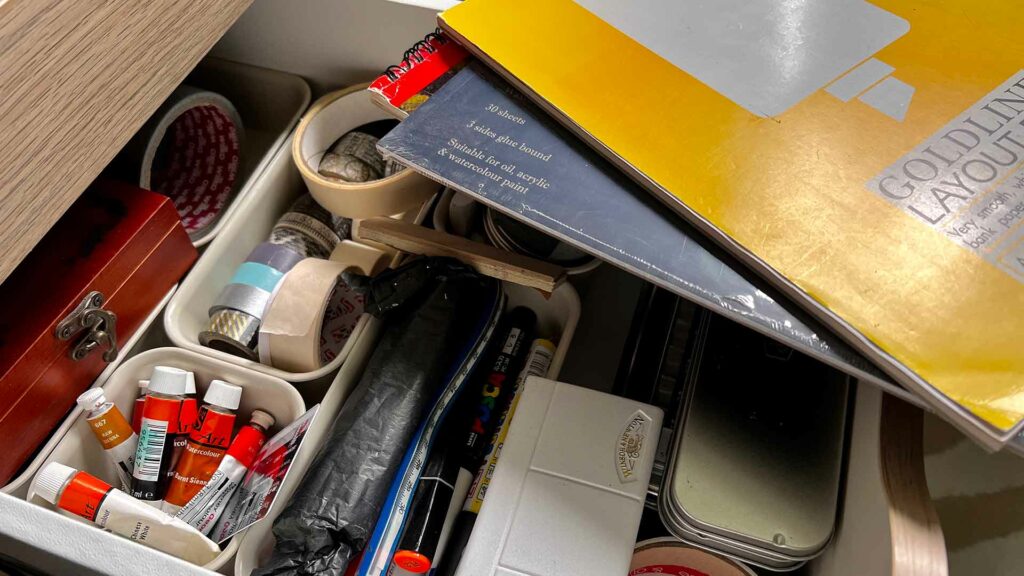
    Messy desk drawer

    I’ve not been happy with my creative space for a while. I don’t mean to sound whiny about that. I don’t have much room to work with and the space that I do have hasn’t been working. At the same time, I am very, very grateful for the space that I do have and I know that I have blamed the space when a lot of the time it is just me not working.

    Anyway, I decided to fix something I have control over. I would get myself a desk and some additional drawer space to ease the creative piles of stuff that often bring me down. So with a bank account that wasn’t looking forward to it, I hopped in the car and popped along to IKEA. A couple of hours later I returned home with a new desk, several drawers and desk tidy, type things with Swedish names.

    The rest of my Bank Holiday was spent moving things around and building the desk – no royal celebrations for me. And also, which is more unfortunate, I didn’t get much time to be creative and move my projects forward. However, I am here, reporting in and staying accountable.

    Creative Field Notes

    The new music collection has nine tracks pretty much confirmed and one empty slot, although I have several possibilities for that. I also found a missing part of one track by bringing it in from another. Cannibalising your own music is allowed… especially if the new arrangement works. Once all the tracks are pretty much agreed upon in my head, and on paper, it will be time to record and rerecord to give them a coherent sound – a This Temple Eden sound.

    This website still needs love and attention, as do several others that I own, run and use. And as a little tease, this is the current iteration of the new The Creative Minimalist logo.

    The Creative Minimalist logo

    I could make 101 excuses as to why I haven’t blogged yet, but the truth is I just haven’t motivated myself to get going. I will remedy that. I’ll soon be back in the swing of talking about creativity in all its breadth as seen through my little corner of the world.

    The creative and learning habits are going well. I have always believed in lifelong learning so giving a little structure to that part of things is good. However, creative habits have been more of a challenge. I have been able to take the time to do them, but it is the play element that is difficult. I’ll explain a little more in a future post to see if it is something that is ongoing once the habit becomes more ingrained.

    Now, I’d best get on with being creative.


    Thank you for reading this post. Please share your thoughts in the comment section below.
    namaste
    d
    xox

    If you enjoyed this post please support my writing by making a donation of any amount.

    Sign up for my (ir)regular newsletter to keep up to date with my creative adventures, including special offers, and join me on Instagram | YouTube | Twitter | Pinterest