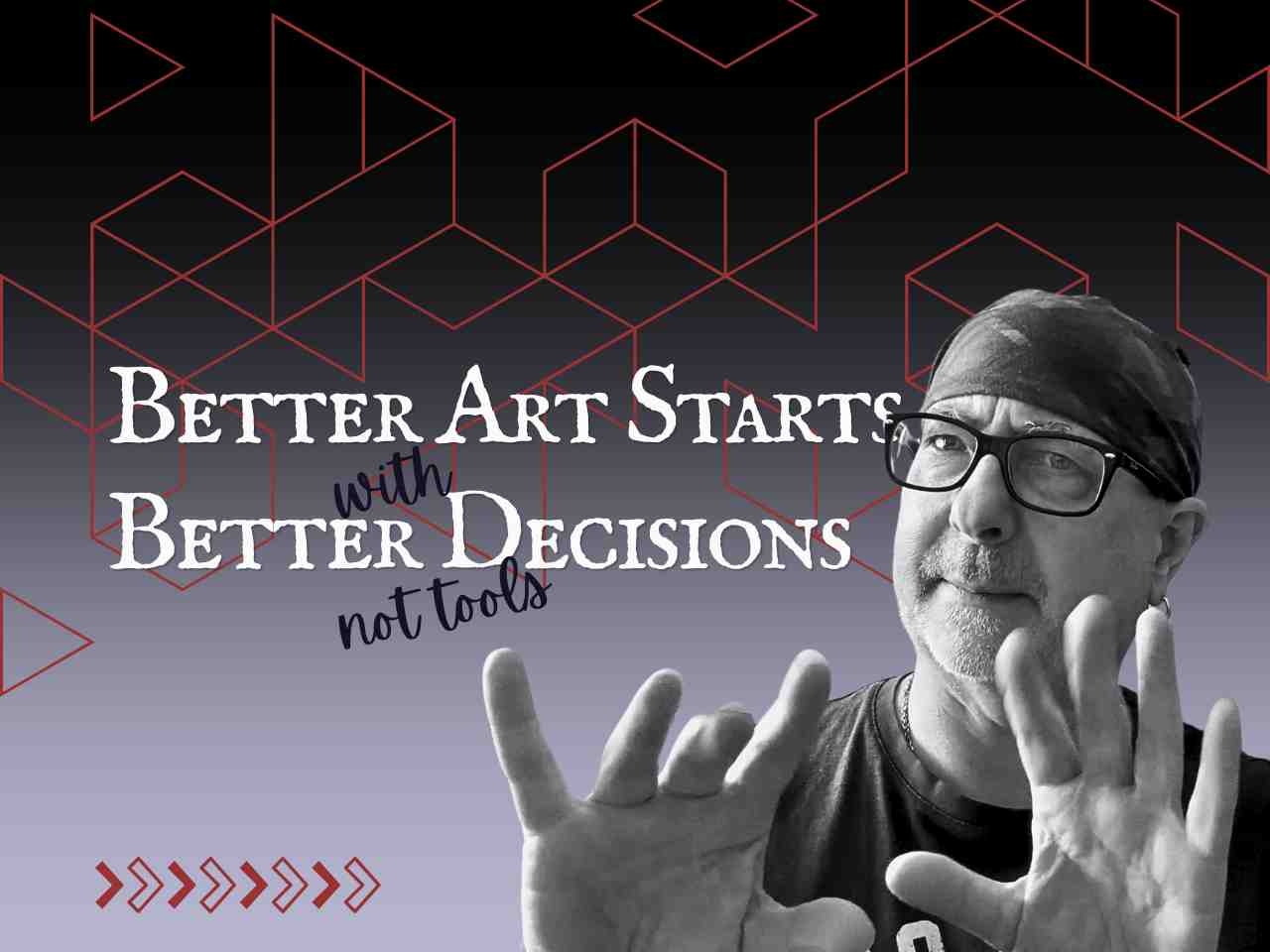
Sometimes your art, your creative piece of work, just isn’t right. You can’t quite see why; it’s frustrating. The mix feels muddy. The photo feels flat. The paragraph feels clumsy. Something’s off, and your instinct is to reach for a fix. A new plugin. A new preset. A new piece of software that promises to sort it out. Yes, it’s the Oh Shiny!
However, a new piece of kit isn’t the problem. The decisions made before you ever thought that are.
The Order Matters More Than the Tools
There’s a well-known piece of advice in music production circles: a poor arrangement will sink a mix long before a poor plugin choice will. As one industry writer put it, a song that suffers from poor arranging is a bigger roadblock to a good mix than almost anything else, and it’s worth thinking hard about arrangement before blaming your gear, or your skills.
The same logic runs through every discipline. A photograph with a weak composition won’t be rescued by better colour grading. A piece of writing with a muddled structure won’t be saved by sharper sentences. A painting with an unresolved composition won’t be fixed by better paints.
The early decisions, the ones made before the polishing stage even begins, set the groundwork for everything that comes after. You can’t edit your way past a structural problem. You can only disguise it, and usually not very well.
This is why so much of the frustration with “not sounding professional yet” or “not looking finished” isn’t actually a tools problem. It’s not even a skill issue. It’s a decisions problem, back upstream.
What Fewer, Better Moves Actually Looks Like
Too often we treat every tool, every effect, every technique as a lever to pull when something feels wrong. Too quiet? Add compression. Too flat? Add a filter. Too plain? Add texture. Each move is small and reasonable on its own. Stacked together, they usually make things worse, not better.
The alternative is fewer, more deliberate moves, applied earlier in the process. A balanced arrangement needs less correcting later. A well-composed photograph needs less cropping and adjusting after the fact. A clearly structured piece of writing needs less rewriting to make it readable.
This isn’t about doing less work. It’s about moving the work earlier, to the stage where decisions actually have leverage, rather than the later stage where you’re mostly compensating for choices you didn’t make on purpose.
Bonus thought: if you find yourself reaching for the same fix repeatedly across different projects, that’s usually a sign the fix belongs earlier in your process, not later.
The Skill That Actually Develops
The skill that separates experienced creatives from beginners often isn’t technical knowledge of tools at all. It’s perception.
Let’s talk chess. Expert players don’t have better raw memory than beginners, but they perceive the board in meaningful chunks rather than individual pieces. Years of practice reorganise how they see the same information. A beginner sees thirty-two separate pieces. A master sees three or four recognisable patterns. You can read more about that here.
The same thing happens with trained ears, eyes, and instincts in creative work. An experienced mixer doesn’t hear more sound than a beginner. They hear the same sound organised into meaningful patterns: this frequency clashes with that one, this element needs space, this section is competing with that one. An experienced editor doesn’t read more words than a beginner. They see structure, pacing, and rhythm where a beginner sees a wall of text.
Perception only develops through practice, and specifically through making decisions and living with the consequences. No plugin teaches you to hear a frequency clash. No preset teaches you to see a weak composition. That skill only comes from doing the work enough times that your ear, your eye, and your instincts start doing the sorting for you.
What to Do Instead
Before reaching for a new tool, ask what decision, made earlier in the process, would have made this problem unnecessary. Usually there’s an honest answer.
Practise the skill of noticing, deliberately. Listen to more finished work with a critical ear. Study the structure of pieces that work. Look closely at compositions you admire and work out why they hold together. That perception compounds in a way that tool knowledge doesn’t.
And when something isn’t working, resist the first instinct to add a fix. Go back one step earlier and ask whether the problem started there instead.

Thank you for reading this post. Please share your thoughts in the comment section below.
namaste
d
xox
If you enjoyed this post please support my writing by making a donation of any amount.
Sign up for my (ir)regular newsletter to keep up to date with my creative adventures, including special offers, and join me on Instagram | YouTube | Twitter | Pinterest