Introduction
This one sounds wrong. Possibly even offensive if you care deeply about what you crate, which I’m guessing you do. “It’s my art and I care about it!”
Lowering your standards? Seriously?
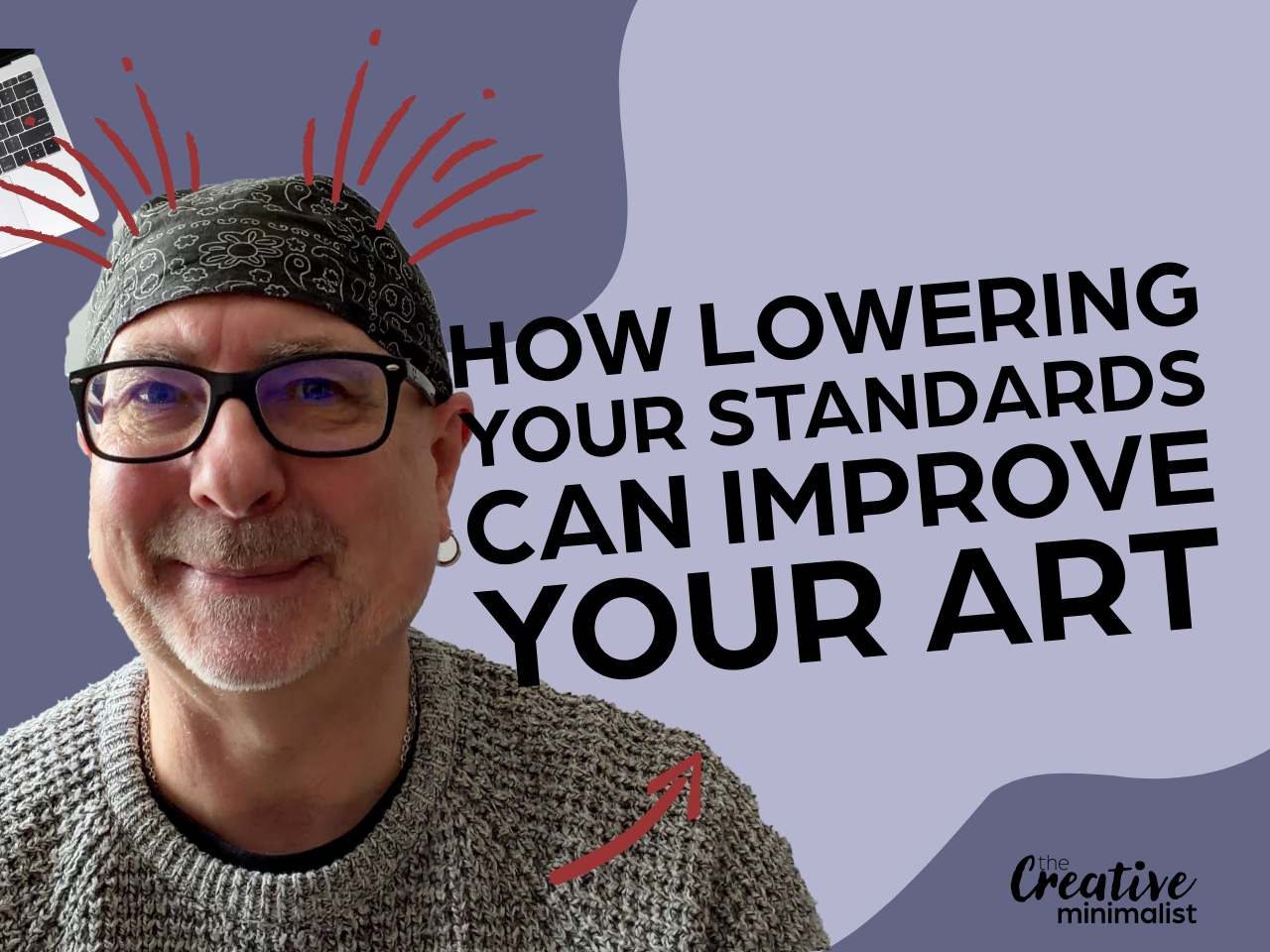
Bear with me. What I’ve found, both in my own creative work and in talking to other creatives, is that high standards applied at the wrong moment don’t give life to your art. They kill it. The thing never gets made, or it gets abandoned halfway through, and the standard you were protecting becomes irrelevant because there’s nothing to apply it to.
There’s a time for high standards. But it isn’t at the beginning.
High standards at the wrong moment block momentum
The first pass at anything is almost never good. That’s not a failure of craft, it’s just how creativity works. The first chord progression is rough. The first paragraph is probably the wrong one. The first sketch looks little like what you had in mind.
If your standard is “this needs to be good before I continue”, you’ll stop at the first pass every time. And stopping at the first pass means you never get to the second, third, or fourth pass, which is where the actual work lives.
High standards are useful for finishing and refining. Applied too early, they become a wall between you and the thing you’re trying to make.
Anne Lamott, one of the most honest writers on the creative process, has a now-famous idea she calls the “shitty first draft”. The point isn’t to celebrate bad work. It’s that giving yourself permission to write badly early on is what unlocks the freedom to actually finish. Perfectionism, she argues, is “the voice of the oppressor”. It doesn’t raise your work. It just keeps you cramped and stuck. (Source: Bird by Bird, via The Marginalian)
Editing needs something to work with
Just think practically about it. You can’t edit a blank page. You can’t refine something that doesn’t exist yet. The raw, imperfect, unfinished thing you’re reluctant to make is the very thing that gives you something to improve.
A rough first draft of a blog post is infinitely more useful than a perfect opening line with nothing after it. A demo recording of a song, even a rough one, is more useful than a melody that only exists in your head.
Getting something out, however imperfect, gives you material. And material is what the editing process needs to do its job.
This is the bit that took me a while to really absorb: the first pass isn’t the work. It’s the raw material for the work. Once I started thinking of it that way, starting became much less frightening.
Quality improves through completion, not avoidance
Ira Glass, the producer behind This American Life, put this better than almost anyone. He talks about the gap that every creative person experiences early on: the gap between your taste (which is probably pretty good, well mine is 😉 ) and your output (which isn’t there yet, well mine is 😳). His prescription isn’t to slow down and be more careful. It’s to do a huge volume of work and put yourself on deadlines.
The only way to close the gap is to keep completing things. Not to keep starting things carefully, or planning better, or waiting until you feel ready. Completing them, even when they’re imperfect, even when they fall short of what you had in mind.
Research backs this up too. A Harvard Business Review piece on perfectionism found that it often blocks productivity and creativity, making people less likely to take creative risks. The fix isn’t to stop caring about quality. It’s to shift your focus during the early creative phase away from fear of getting it wrong, and toward the process of making and finishing. (Source: The Pros and Cons of Perfectionism According to Research, Harvard Business Review)
Our standards can absolutely rise later. But only if there’s something there for them to rise on.
Practical takeaway
Next time you feel your standards stopping you before you’ve really started:
- Give yourself a first pass with no judgement. Just make the thing.
- Remind yourself that editing needs raw material. The rough version isn’t the end product, it’s the beginning of it.
- Finish something imperfect. Then finish another thing. The quality follows the volume, not the other way around.
Lowering your standards early isn’t giving up on quality. It’s giving yourself permission to reach it.

Thank you for reading this post. Please share your thoughts in the comment section below.
namaste
d
xox
If you enjoyed this post please support my writing by making a donation of any amount.
Sign up for my (ir)regular newsletter to keep up to date with my creative adventures, including special offers, and join me on Instagram | YouTube | Twitter | Pinterest
Leave a Reply