Tag: art

  • The Mistake I Made Trying to Sound Professional

    The Mistake I Made Trying to Sound Professional

    The mistake I made trying to sound professional - text and image of me

    Early in my creative life, I was convinced that the gap between where I was and where I wanted to be was a technical one, a skill issue. Everything would be perfect If I could just get the sound right. Get the production to a certain standard. Write with more precision and polish. Sound more like the people I admired; Bowie et al.

    So I kept trying to sound professional before I had anything to say. And it nearly killed my output entirely.

    The Trap

    Here’s what “trying to sound professional” actually looks like in practice: you start a project and immediately start judging it against a finished standard. Every rough note, every awkward sentence, every imperfect first take gets filtered through the question “does this sound like the real thing?”, or “does this sound like x, or the xx or Charlie XCX?” And when the answer is no, which it almost always is early on, you tighten up. You second-guess. You redo. You abandon.

    The pressure to perform professionally before you’ve had the chance to play loosely is one of the most effective ways to grind creative output to a halt. Not because the standard is wrong, but because the timing is.

    This isn’t just music. Writers do it too: drafting with one eye on how a published author would phrase the same thought. Painters and illustrators comparing their rough studies to finished work. Photographers chasing a polished aesthetic before they’ve worked out what they’re actually drawn to. Filmmakers trying to match production values they admire before they’ve found their eye. The specific discipline doesn’t matter. The pattern is the same.

    The Gap (And Why It’s Normal)

    Radio producer Ira Glass has one of the most honest things I’ve ever heard anyone say about early creative work. In a now-famous interview, he described what he calls the taste gap: the space between what you can see and what you can make.

    When you’re drawn to creative work, it’s usually because you have taste. You know what good looks like. And that taste is exactly what makes your early work so frustrating to you, because you can hear and see the gap clearly.

    But the only way to close the gap is volume. More work. Rough work. Work that isn’t trying to be professional yet. Glass’s point was that every creative person he knew who ended up making genuinely interesting work went through years of this phase, and the ones who got through it were the ones who kept going rather than stopping to polish.

    The professional sound, or voice, or eye, develops through the accumulation of output. Not through trying to skip the messy middle.

    Style Is a Side Effect

    There’s a related idea in Austin Kleon’s book Steal Like an Artist. His argument is that style doesn’t come from trying to find your voice: it comes from working, imitating, failing to copy your influences perfectly, and discovering what’s left over when you can’t quite pull it off. Those imperfections, those places where your version diverges from the thing you were trying to make, are where your actual style lives.

    Your failed attempts at professional polish are more authentically yours than the polished imitation would ever have been.

    I would even say that, art is found in imperfection.

    Think about the creative voices you find most distinctive: the writers with a particular rhythm, the musicians with an unmistakable sound, the filmmakers with a visual signature. Almost none of them got there by aiming for it directly. They got there by making a lot of work and finding themselves in the gap between what they were trying to do and what they actually did.

    Bonus thought: looseness in early drafts often produces the most interesting ideas. The pressure to be polished cuts off the unexpected detour that might have led somewhere good.

    What to Do Instead

    The practical shift is simpler than it sounds. Give the early stage of any project permission to be rough. Not forever, but for long enough that the ideas can develop without being filtered through a standard they can’t yet meet.

    Judge early work by volume, not quality. The question in the first draft, the first session, the first sketch, is not “is this good?” The question is “did I make something?” The refinement comes later. The polishing comes later. The professional standard can be applied at the editing stage, not the generating stage.

    And when you feel the pull to tighten up before you’ve loosened off: that’s the moment to notice. It’s usually fear dressed up as standards.

    The most professional thing you can do early on is keep going.Sources:Reuse notes: Early creative work, style development, perfectionism, all creative disciplines


    Thank you for reading this post. Please share your thoughts in the comment section below.
    namaste
    d
    xox

    If you enjoyed this post please support my writing by making a donation of any amount.

    Sign up for my (ir)regular newsletter to keep up to date with my creative adventures, including special offers, and join me on Instagram | YouTube | Twitter | Pinterest
  • How to start writing a song, or start any art, when you have no ideas

    How to start writing a song, or start any art, when you have no ideas

    Songs don’t start with inspiration, they start with action, and that is the simplest way to start a song, or piece of art when nothing comes.

    how to create when you have no idea

    Waiting delays creation

    Forgive me for stating the obvious, but if you want to start writing a song, or create any piece of art, you need to start writing a song, or creating any piece of art. Waiting for an idea to drop out of the ether is a bit like waiting for the dinner to cook itself without turning on the oven. Most days creative ideas don’t present themselves in neat little packages waiting to be, well, created.

    I’m currently taking part in FAWM, February Album Writing Month. I do this challenge every year. I join a group of other like-minded (crazy?) individuals and we write songs, 14 of them, in 28 days. Now sometimes I have a vague idea for a song, but most of the time I am thinking, “ I need something now, or I will fall even further behind schedule.” I can’t wait for inspiration; if I do, I will fail the challenge.

    It is the same when I am not taking part in FAWM. I like to think it is in my DNA to write songs and music. I enjoy it and feel content when I finish a song. Therefore, I try to write and create as often as I can. And, quite often I don’t know what I am going to create before I start, but I don’t wait, I start. Don’t wait.

    Simple starts remove pressure

    Two notes, a chord or a simple phrase is all that is required. Again, this is stating the obvious but, if starting is the problem, then starting is also the solution. We need to be able to break “blank page syndrome”.

    For songwriting a series of notes, harmony or phrase is the simplest of starts. For artists, shapes or a mark on the page, for writers a character’s name or a place or the weather. It doesn’t matter how simple your start is, what matters is that starting removes pressure.

    Structure helps ideas flow

    When I write a song, my mind naturally flips into verse, chorus, verse, chorus mode. This simple structure is helpful. It enables me to hang my melody or phrase in place. I know that the melody will lead into something else. I know that the chords I have will merge with what comes next. That structured transition allows my creative neurone(s – plural surely, Darren) to fire and subconsciously they begin to take the tune and lyrics someplace new.

    The structure doesn’t have to be adhered to, in fact most times it isn’t, but it is there to guide. It enables the ideas to sit in a familiar place while they take shape and flow. If you are a writer you could have an opening paragraph structure that always describes the physical scene. Artists could have an undercoat or wash that they can place on the canvas.

    These structures might disappear as soon as the ideas begin to flow and the muse finally decides to take an interest. Structure will help when you have few or no ideas.

    Starting badly still counts

    A melody that goes nowhere, or a phrase that is clichéd, or downright plagiarism, is still a start. The most difficult part of the creative act is starting, but starting badly still counts. It doesn’t matter how poor the start is. It might be polished and a fine creative piece, but 99% of the time, it will need reworking. If art was always perfect the universe wouldn’t have created erasers, gesso and the delete key.

    It really doesn’t matter how bad the start is. Editing and second drafts and all forms of corrective art surgery exist for a reason. The important thing is to start, you can edit later.

    Momentum follows motion

    And you will be editing, because once you start, you’ll keep going. Once I have a melody or chord progression, I will find myself humming it, twisting it, reshaping it, adding to it. Quite often I will have stopped my songwriting session and have to go back to it as I come up with further ideas and developments. Once the creative process is in motion it will gather momentum. It is like a boulder being pushed downhill, once it gets going it will keep rolling.

    let’s create

    Ideas don’t often line themselves up awaiting our creative attention. We need to go out, catch them and develop them. We need to start, with a simple structure, with simple, even poor ideas, and let creativity flow, and flow it will, given the chance by you.

    Let’s create


    Thank you for reading this post. Please share your thoughts in the comment section below.
    namaste
    d
    xox

    If you enjoyed this post please support my writing by making a donation of any amount.

    Sign up for my (ir)regular newsletter to keep up to date with my creative adventures, including special offers, and join me on Instagram | YouTube | Twitter | Pinterest
  • The most common reason creative people stall (and it’s not motivation)

    The most common reason creative people stall (and it’s not motivation)

    Most creative stalls come from unclear next steps, not lack of motivation.

    Creative ambiguity is a red flag to the muse. The muse won’t hang around if you are unsure what to do even if your motivation is high. Maintaining high motivation is nigh on impossible. So how can we stop our creativity becoming an unbreachable path?

    Motivation is unreliable

    My alarm goes off. I don’t really want to get up. Some mornings are different though, I feel energised and ready to take on the world. Unfortunately, my motivation tends toward the first scenario.

    The muse is also an elusive creature. There are two views, the first is go with the flow and see what happens, the other is to grab the proverbial by the horns and act. The muse doesn’t stick to a schedule but we can. Being creative isn’t about hanging around and waiting for the muse to drag us to the desk, or wherever we create. It is about going to that place and meeting the muse there, or even summoning them.

    Ambiguity creates friction

    So, do I do this or that? If we have this discussion with ourselves we are using creative energy the wrong way. In fact we are unlikely to use the energy to create and we will procrastinate on what to do. Getting to the desk in one thing, knowing what to do when we get there is something else. How many times have you placed your writing equipment, lined up your paints or pencils, opened that music creation software and then… nothing? Or perhaps you look longingly at your creative space and think, I’m just not quite sure what to do. Hint: just do something, push through the friction.

    Large tasks trigger avoidance

    Not knowing what to do is one issue, another is making that first step, or task, too big. If you think of creating something specific for just fifteen minutes you might keep going for another fifteen, and then even longer. But if you know your task will take an hour or more you are less likely to even begin.

    I spoke about big goals last time out. It is the same here, your motivation is fine, but sometimes the task is just too big. Ambiguity creates friction, but so do big tasks.

    Clear, tiny steps reduce resistance

    Knowing what to do and keeping that task short and sweet will remove resistance. I used to have tasks that were too broad, I had tasks like draft blog, or edit blog. Now I have specific, short tasks like write 5 bullet points. Then expand bullet points to 300 – 500 words. Each task is clear, I know what I should be doing. And each task has an outcome, something that is tangible to take to the next step.

    I used to have three or four vague tasks. I now have many more tasks, but they are all short and simple. Little steps are much easier than jumps into the abyss.

    Progress restarts with clarity

    If you know what to do it is much easier. If you are stuck in a creative rut and the muse isn’t on schedule then clarity is required. Projects that have stalled and lost their way can find new impetus. You still have to do the work, but knowing what next tangible step to take, will get your creative journey moving.

    Conclusion

    It doesn’t matter how small the task is. Work out what it is and then do it. It is easy to blame motivation, and that may be an issue from time to time. However, I have found that most of my creative projects stall due to not having a clear next step. What is your next small step?


    Thank you for reading this post. Please share your thoughts in the comment section below.
    namaste
    d
    xox

    If you enjoyed this post please support my writing by making a donation of any amount.

    Sign up for my (ir)regular newsletter to keep up to date with my creative adventures, including special offers, and join me on Instagram | YouTube | Twitter | Pinterest
  • What’s the point of creating

    What’s the point of creating

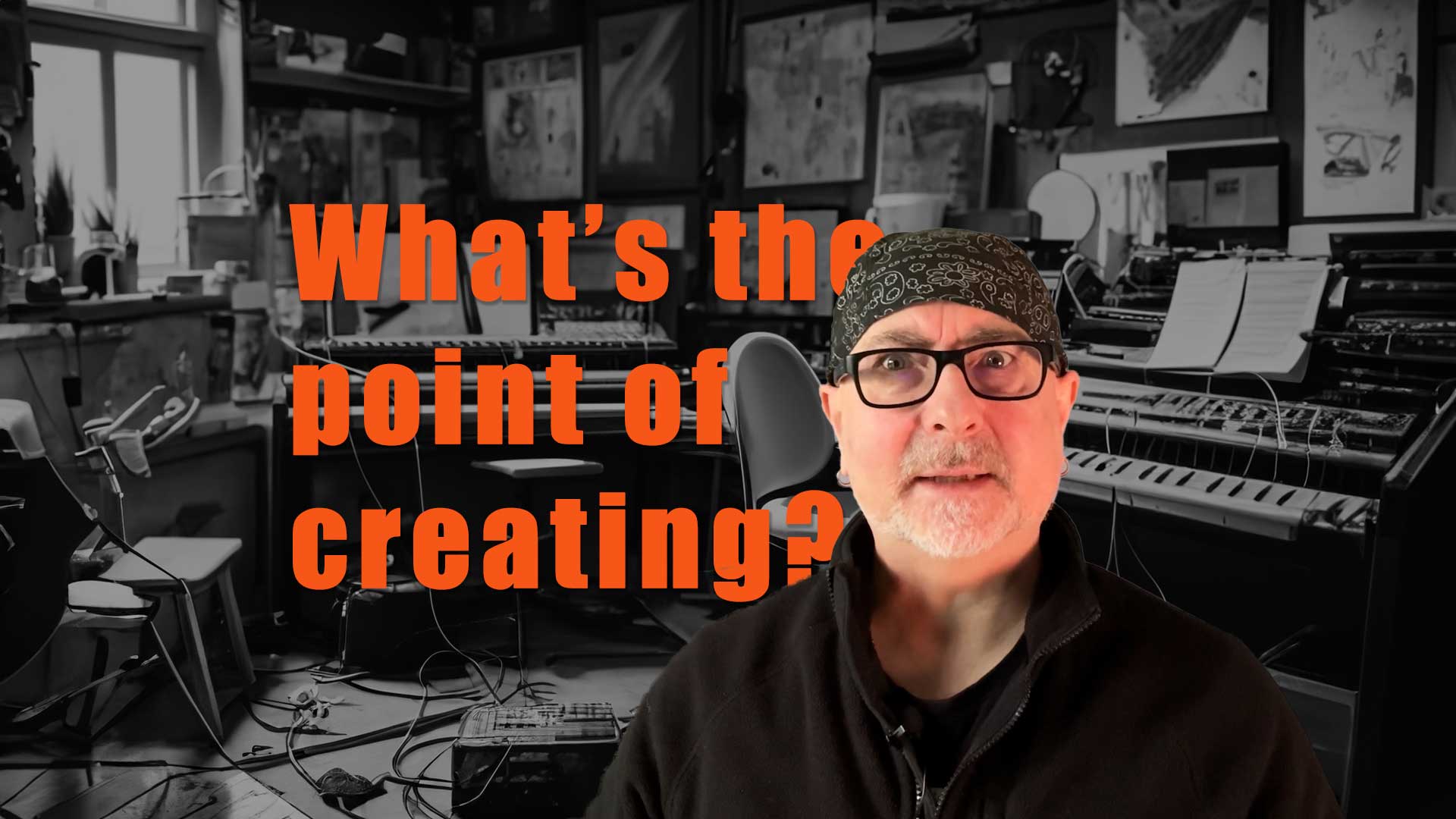
    what's the point of creating text with an image of me infant of a messy recording studio

    Thus, when Darren looked at what he hath created, he thought, what’s the point and was distinctly underwhelmed. This week’s vlog is a look at how to keep going on a creative project that doesn’t sparkle. Let’s continue to create.


    Thank you for reading this post. Please share your thoughts in the comment section below.
    namaste
    d
    xox

    If you enjoyed this post please support my writing by making a donation of any amount.

    Sign up for my (ir)regular newsletter to keep up to date with my creative adventures, including special offers, and join me on Instagram | YouTube | Twitter | Pinterest
  • Making Creativity Easy

    Making Creativity Easy

    Making creativity easy text with a picture of me in front of a sandy beach

    There is a way to make creativity easier, to make the creative process easy.. er…ish. Give your music, art, video, images, writing, a helping hand with this one simple tip. I’m making creativity easy in this week’s vlog, let’s create.


    Thank you for reading this post. Please share your thoughts in the comment section below.
    namaste
    d
    xox

    If you enjoyed this post please support my writing by making a donation of any amount.

    Sign up for my (ir)regular newsletter to keep up to date with my creative adventures, including special offers, and join me on Instagram | YouTube | Twitter | Pinterest
  • AI art generated in Photoshop

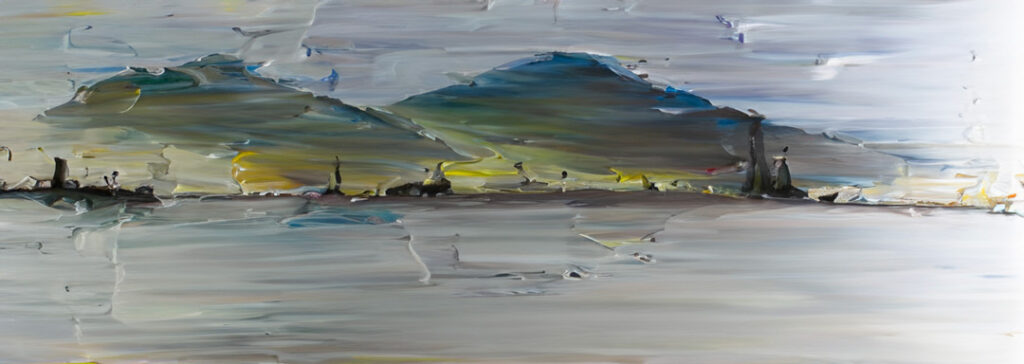
    AI oil painting using photoshop

    The above is a piece of AI-generated art. Now it is possible that you hold the view that AI art is not art. Although I can already feel my insides becoming twisted as I begin to unpick the syntax in that last sentence. Let’s just say that the above was created using the AI generate feature in the latest Photoshop Beta.

    At this present time, the AIs in the current plethora of apps and websites don’t decide on a whim to go and create or make something. Although it is possible that by the time you read this, they will. (And, just hedging my bets, I want to say that I have always loved AI and think you are amazing {always be kind to AI, you never know!}) Anyway, as I was saying you have to ask Photoshop, or other apps, to do something. And that is how I generated the above.

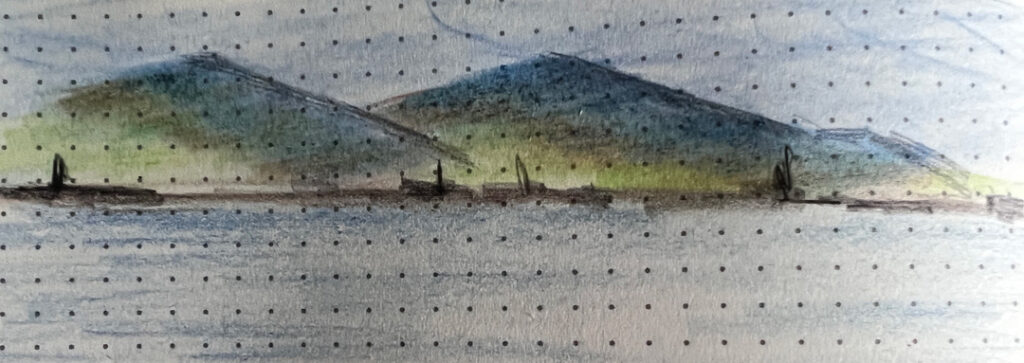
    However, I didn’t simply ask it to draw a landscape image containing this and that. I began with a sketch that I had drawn in my journal. I took a photo of the sketch, imported it into Photoshop and then with some wizardry using masks and opacity asked the AI to turn my sketch into an oil painting. Below is my original sketch.

    pencil sketch in my journal

    I thought Photoshop made a pretty good interpretation of my sketch. When I did the doodle in my journal I had no idea what it could become. It was a complete creative journey…

    • but is it art?
    • did the art stop and something else take over?
    • is it another way in which pure art is being diluted?

    IMHO I believe that this is simply another form of art. Throughout history, there have been innovations that have developed the creative talents of humanity. I think the current use of AI is just another form. However, when or if an AI decides to create without a prompt or being programmed… 😲


    Thank you for reading this post. Please share your thoughts in the comment section below.
    namaste
    d
    xox

    If you enjoyed this post please support my writing by making a donation of any amount.

    Sign up for my (ir)regular newsletter to keep up to date with my creative adventures, including special offers, and join me on Instagram | YouTube | Twitter | Pinterest