
Tag: productivity tips

  • What Actually Matters in a Home Creative Space

    What Actually Matters in a Home Creative Space

    What actually matters in a home creative space text with an image of a creative studio and me

    I want to tell you about the worst creative studio I ever worked in. A cupboard, basically. Barely enough room to swing a mic stand, one window that didn’t open, and a chair that made my back ache after twenty minutes. It was really cuboardy.

    Some of my proudest creative moments came out of that room.

    The point is, I think we get the home creative setup question backwards. We ask what we need to add: better acoustic treatment, a bigger desk, more shelving, more paint holders, more IKEA trolleys, a proper monitor stand, instead of the stack of books currently doing the job (my credit card company thanks me for that particular phase, by the way). And most of those additions, if I’m honest, barely made any difference to my creative output.

    So here’s what I think actually matters. Three things, and none of them cost anything.

    Your Creative Space Doesn’t Need to Impress Anyone

    This one took me embarrassingly long to work out. I used to think my space needed to look like the studios I saw online: the tidy shelves, the perfectly positioned monitors, the plant that’s somehow always thriving. I spent real money and real time chasing that perfect creative look.

    None of it made my creative output better. Writers don’t need the aesthetic writing desk from the magazine spread. Painters don’t need the studio with the north-facing light everyone, I mean everyone, talks about. Photographers don’t need the perfectly organised kit bag. What you need is a space that works for you, which is a much lower and much more achievable bar than a space that impresses anyone else, including yourself, scrolling through other people’s setups at midnight.

    I still catch myself doing it sometimes. Looking at someone’s beautifully lit desk and feeling my own workspace falls short by comparison. It’s a trap, and I don’t think I’ll ever be fully immune to it. But I know to kick myself now when it happens, which helps… and hurts.

    The Same Space, Over and Over, Does Something

    Choreographer Twyla Tharp writes about this in her book on creative habits: she describes how habitually creative people build rituals tied to their working environment, and how just entering that space starts the creative process before any actual work begins. She tells the story of Stravinsky, who played the same Bach fugue on piano every single morning before composing, in the same room, at the same time. Not because the fugue mattered, but because the ritual of that room, that routine, told his brain it was time.

    I didn’t understand this until I noticed it happening to me. There’s a specific corner of my house where, within a few minutes of sitting down, my brain just switches into work mode. It’s not a nice corner. It’s not well lit. But I’ve sat there enough times doing the same kind of work that the space itself has become part of the trigger.

    Bonus thought: if you don’t have a dedicated space, a consistent object works – the same notebook, the same chair, the same mug. The brain latches onto whatever repeats.

    This is worth more than almost any piece of gear, or “perfect” studio. A familiar space that reliably gets you into the work is doing something no upgrade can replicate.

    Clutter Is Quietly Taxing You

    The last one is the most measurable. Research out of Princeton found that visual clutter forces your brain’s visual processing centres to work through everything in view, whether you’re paying attention to it or not, and that this uses up mental resources you’d otherwise have for the actual task. A cluttered space really does create a cluttered mind. Oops!

    This doesn’t mean minimalist in the aesthetic sense, all white walls and empty surfaces. It means resolved. The distortion pedal you’re not using put away rather than left tangled on the floor. The reference photos you’re not currently using filed rather than pinned up alongside the ones you are. Not because mess is a moral failing; it absolutely isn’t, but because your brain is quietly spending energy processing all of it whether you like it or not.

    I’m not naturally tidy. But I noticed the difference when I started closing the loop on things I wasn’t using, rather than letting them accumulate in my eye line.

    I know this can be difficult. I have my guitar on a stand next to me, always. I look at it, and my mind immediately jumps to forming chord progressions. That’s great when I need to make some music, not so good when I am trying to write words on a screen or notebook. It can be a delicate balance, but worth one worth seeking.

    What to Do Instead

    Don’t audit your gear list first. Audit what’s actually in your field of view when you sit down to work, and clear out what isn’t earning its place there.

    Build a small, boring ritual around your space if you don’t already have one. It doesn’t need to be interesting. It just needs to be repeated.

    And the next time you’re tempted to upgrade something because someone else’s setup looked better online, ask yourself honestly whether the upgrade would change the work, or just the photo of the work. Usually it’s the second one.

    The cupboard I mentioned didn’t have any of the right gear. It had a chair, a window that didn’t open… but enough repetition that sitting down in it eventually just meant it was time to work. Turns out that was most of what mattered.


    Thank you for reading this post. Please share your thoughts in the comment section below.
    namaste
    d
    xox

    If you enjoyed this post please support my writing by making a donation of any amount.

    Sign up for my (ir)regular newsletter to keep up to date with my creative adventures, including special offers, and join me on Instagram | YouTube | Twitter | Pinterest
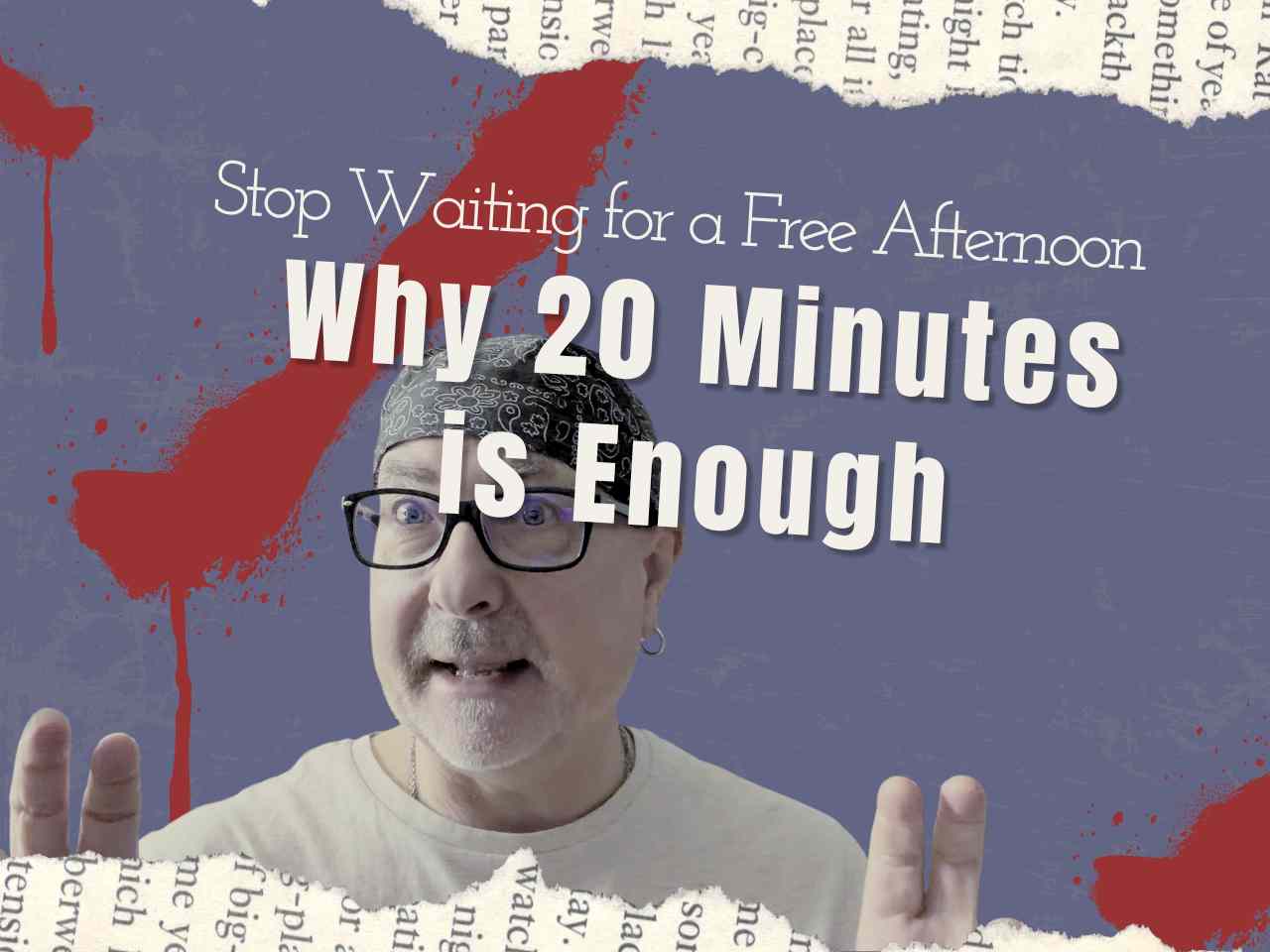
  • Stop Waiting for a Free Afternoon: Why 20 Minutes Is Enough to Create

    Stop Waiting for a Free Afternoon: Why 20 Minutes Is Enough to Create

    Stop waiting for a free afternoon: why 20 minutes is enough to create - text

    There’s a perfect zone where creative work only happens when the conditions are right. A clear day. A tidy workspace. A long, uninterrupted stretch of time with nothing else pressing. Creative heaven.

    And there’s a place that it happens anywhere. In the gap before the school run. On a lunch break. In twenty minutes before the rest of the house wakes up.

    Many of the people who consistently make things are the second type. Not because they have more time. Because they stopped waiting for the right conditions and started using the ones they had.

    The Myth of the Long Session

    The assumption that creative work requires long, uninterrupted sessions is one of the most effective ways to never make anything.

    Because long, uninterrupted sessions are rare. Life doesn’t schedule itself around your creative ambitions. And when the window doesn’t open, the work doesn’t happen.

    What fills the gap is a specific kind of guilt: I should be working. But the logic running underneath it is: I don’t have long enough to make it worth starting. So nothing happens.

    The belief that short sessions don’t count is costing more creative output than almost anything else. Not because short sessions are ideal, but because they’re available while the long session often isn’t.

    And here’s the thing: science suggests the short session might not be the compromise you think it is.

    What the Research Actually Shows

    The well known landmark study by Baddeley and Longman from 1978, trained postmen to type using different session lengths. Those taught in shorter sessions spread across multiple days didn’t just keep up with those who had longer, massed sessions. They outperformed them, with better accuracy and speed, and the advantage grew over time.

    This is distributed practice: the principle that many short sessions, spaced across time, consistently outperform fewer long ones for skill retention and development. It’s been replicated across dozens of skills and contexts since, and it holds up.

    The reason seems to be consolidation: the brain processes and integrates what it has practised during the rest periods between sessions. A long session can accumulate a lot of repetition without giving the brain time to absorb it. Short sessions, by contrast, force exactly the kind of spaced repetition that produces durable skill.

    This applies directly to creative work. Twenty minutes of focused writing, playing, drawing, or editing, done consistently, will develop your skills faster than the occasional marathon session that gets squeezed in when life allows. Find these 20 minute creative habit nooks.

    Bonus thought: twenty focused minutes beats two distracted hours every time. The constraint forces the focus.

    The Hemingway Trick (And the Science Behind It)

    There’s a practical technique that makes short sessions even more effective, and it’s been in use since long before anyone had a name for it.

    Ernest Hemingway famously stopped writing each day at a point where he knew exactly what came next. Not at the end of a section. Not at a natural stopping point. In the middle of something. Sometimes mid-sentence.

    The reason this works is the Zeigarnik effect: a 1927 discovery by psychologist Bluma Zeigarnik showing that the brain holds on to unfinished tasks far more persistently than completed ones. Incomplete things create a cognitive pull. They stay active in the background.

    Stopping in the middle of a session, with clear momentum still in the work, means the creative thread stays live between sessions. You’re not walking away from a completed creative idea; you’re leaving a door open. And when you come back, you’re not starting cold. You’re completing something that’s already in motion, already in the creative flow.

    This transforms the short session from a frustrating limitation into a deliberate technique. You’re not squeezing in twenty minutes. You’re setting up the next twenty minutes before you leave.

    What to Do Instead

    Three practical shifts that make short sessions work:

    Make the session specific before you start. “Work on the song” is too open. “Finish the chorus melody” or “write the next 200 words” gives the twenty minutes a clear edge. You spend the time on the work, not on deciding what the work is. And provides a tangible outcome.

    Start before you’re ready. The warm-up is part of the session. The first five minutes of any creative session are usually the most resistant. Push through them rather than waiting for inspiration to arrive first: it rarely does.

    Stop with something to return to. Take the Hemingway approach. Don’t finish the thought. Leave a note for your next session: where you are, what comes next, what you were trying to do. The Zeigarnik effect will do the rest.

    Twenty minutes, done consistently and deliberately, is not a substitute for longer creative work. But it’s not a consolation prize either. It’s a different shape of the same thing. And it’s available today, even if, or when, the free afternoon isn’t.


    Thank you for reading this post. Please share your thoughts in the comment section below.
    namaste
    d
    xox

    If you enjoyed this post please support my writing by making a donation of any amount.

    Sign up for my (ir)regular newsletter to keep up to date with my creative adventures, including special offers, and join me on Instagram | YouTube | Twitter | Pinterest